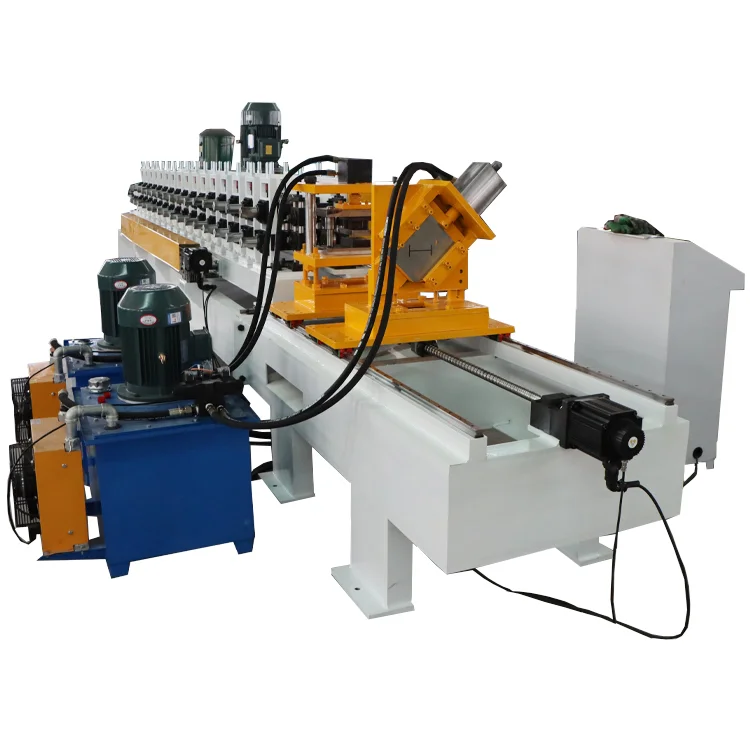
Modern construction is shifting toward lightweight, high-strength materials to reduce labor costs and increase structural speed. At the center of this transition is the light gauge steel framing machine, a precision engineering tool designed to cold-form thin steel coils into structural profiles with millimeter accuracy.
Unlike traditional heavy steel beams, light gauge steel (LGS) relies on the geometric strength of C and Z sections. The efficiency of producing these profiles depends entirely on the roll forming technology used, where consistency in the profile cross-section directly impacts the load-bearing capacity of the final building frame.
For developers and manufacturers, selecting the right equipment means balancing production speed with the ability to handle various gauges. Understanding the technical nuances of these machines is essential for optimizing operational ROI and ensuring compliance with international building standards.

The Technical Mechanics of Cold Roll Forming for LGS

A light gauge steel framing machine operates on the principle of progressive deformation. A flat strip of galvanized steel is passed through a series of strategically designed rollers that gradually bend the material into a specific profile—most commonly C-channels or U-tracks—without the need for heat.
The precision of the rollers is critical; any misalignment can lead to "twist" or "bow" in the longitudinal axis of the member. High-quality equipment utilizes hardened steel rollers with specific coatings to minimize friction and prevent surface scratching on the galvanized layer, which is vital for corrosion resistance.
Beyond simple bending, these systems integrate cutting mechanisms. Depending on the configuration, these can be mechanical shears or hydraulic cutters that truncate the profile to an exact length, ensuring that the framing components fit perfectly during the assembly phase on the construction site.
Core Performance Drivers in Framing Equipment
The value of a framing machine is not measured solely by its speed, but by its ability to maintain tight tolerances across thousands of linear meters. Key drivers include the rigidity of the machine frame and the quality of the PLC control system.
A robust chassis prevents vibration at high speeds, which is essential for maintaining the dimensional stability of the light keel or stud. When combined with an intelligent PLC, operators can adjust lengths and quantities instantly, reducing material waste and downtime between different batch runs.
Furthermore, the integration of decoilers ensures a continuous flow of raw material. For high-volume operations, a synchronized uncoiling system prevents tension spikes that could warp the steel before it even enters the forming rollers.
Versatile Applications from Residential to Industrial Frames
Light gauge steel is no longer limited to simple interior partitions. Modern machines enable the production of load-bearing walls and roof trusses that compete directly with traditional timber and heavy steel.
In residential construction, the equipment is used to create drywall studs and tracks, providing a fire-resistant and termite-proof alternative to wood. In industrial settings, the focus shifts to Purlin roll forming (C/Z/U profiles), which provide the primary structural support for large-span warehouse roofs.
Specialized applications also include the production of greenhouse gutters, floor deck tiles, and highway guardrails. The flexibility to customize the profile drawing allows manufacturers to enter niche markets, such as agricultural silos or specialized water tank sheet forming.
Analyzing Production Efficiency and Precision Benchmarks
Measuring the impact of an advanced light gauge steel framing machine involves comparing manual or semi-automated processes against fully integrated cold-roll lines. The primary gains are seen in waste reduction and throughput consistency.
When examining performance, we look at the "yield rate"—the percentage of finished products that meet the strict dimensional tolerance of the architectural plan. Automated systems significantly raise this benchmark by removing human error from the cutting and forming phases.
light gauge steel framing machine Performance Metrics
The data indicates that while traditional methods may be sufficient for small-scale custom work, high-capacity projects require the stability of a professional roll forming line to maintain schedule and budget.
Procurement Strategies for High-Output Roll Forming Lines
Investing in roll forming equipment requires a deep dive into the technical specifications of the machine's components. Procurement should not be based on price alone, but on the long-term durability of the roller shafts and the flexibility of the control system.
Buyers must evaluate whether the machine supports "interchangeable size" capabilities. For those producing various stud widths, an auto-interchange system reduces the need for multiple machines, drastically lowering the factory footprint and capital expenditure.
Additionally, after-sales support and the ability to customize profile drawings are critical. Since different regions have different building codes, the ability to refine the roller geometry ensures the equipment remains relevant as standards evolve.
The Shift Toward Automated and Servo-Driven Systems
The industry is currently witnessing a transition from hydraulic systems to servo-motor control. Servo technology allows for near-instantaneous acceleration and deceleration, which is paramount for precise length cutting in LGS.
These advanced systems reduce mechanical wear and tear, as they eliminate the jarring shocks associated with traditional hydraulic stops. This leads to a longer machine lifespan and a significant reduction in operational noise and energy consumption.
Looking forward, we may see deeper integration with BIM (Building Information Modeling) software, where architectural designs are fed directly into the machine, automating the production of every unique frame piece for a specific building project.
Evaluating LGS Solution Types by Project Requirement
Not all framing machines are created equal. Depending on whether the goal is residential interior work or heavy industrial structural support, the equipment specifications must vary.
The following table outlines the primary differences in technical approaches based on the intended output and operational environment.
| Solution Type | Primary Profile | Control System | Ideal Application |
|---|---|---|---|
| Drywall Stud Line | C/U-Channel | PLC Basic | Interior Partitioning |
| Structural Framing | Heavy C-Section | Servo-Driven | Load-bearing Walls |
| Purlin Production | Z/C Purlins | High-Speed PLC | Industrial Warehouses |
| Keel Forming | Light Keel | Auto-Interchange | Ceiling Grid Systems |
| Specialty Sheet | Silo/Tank Sheet | Custom Mechanical | Agricultural Storage |
| Modular Frame | Complex Multi-profile | BIM Integrated | Prefabricated Housing |
Choosing the correct configuration ensures that the production line is neither over-engineered for simple tasks nor under-powered for structural requirements.
Frequently Asked Questions
Conclusion
The adoption of a high-precision light gauge steel framing machine is a strategic move for any construction-focused enterprise aiming to scale production while maintaining strict quality control. By moving away from manual fabrication and embracing automated cold-roll forming, manufacturers can drastically reduce lead times and material waste.
As the industry moves toward more sustainable and prefabricated building methods, the role of precise steel framing will only grow. For those evaluating their production capabilities, the detailed product range and technical solutions available at www.hyrollformingmachine.com provide a comprehensive starting point for optimizing structural manufacturing.